
What Is Ryzodeg and How Do I Use It?
Medically reviewed by Dr Sultan Linjawi, Endocrinologist & Diabetes Specialist — September 2026
Ryzodeg 70/30 is a mixed insulin that combines two types of insulin in one pen: 70% ultra–long-acting basal insulin degludec and 30% rapid-acting insulin aspart. It is used in people with type 2 diabetes and, in selected cases, type 1 diabetes to provide both background and mealtime insulin coverage. This article explains, in simple language, what Ryzodeg is, who it may suit, how it differs from older premixed insulins, how it is dosed and adjusted, and how to use it safely.
If you would like a broader overview of diabetes treatment before you dive in, you may find it helpful to read How is diabetes treated? or Managing diabetes with insulin – is it necessary?, and then come back to this page.
What is Ryzodeg 70/30 insulin?
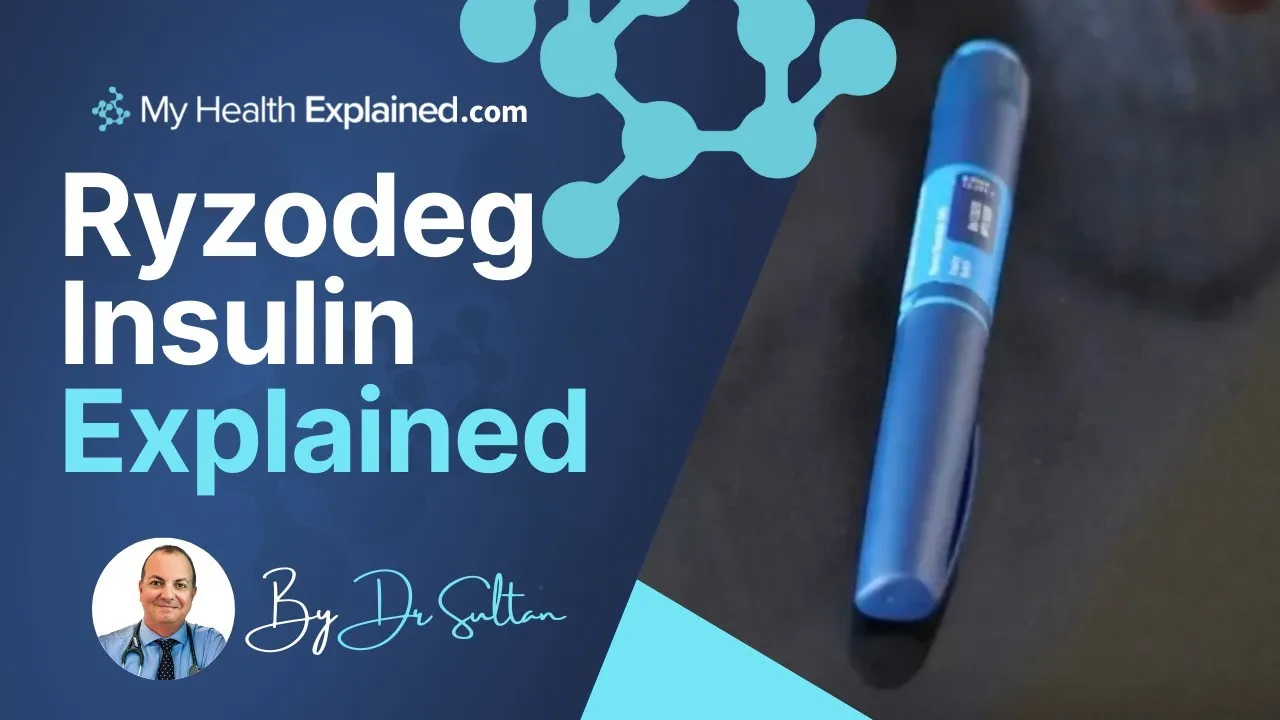
Ryzodeg 70/30 (insulin degludec/insulin aspart) is a mixed insulin that contains 70% ultra–long-acting basal insulin degludec (brand name Tresiba) and 30% rapid-acting insulin aspart (brand name Novorapid/Novolog). It is manufactured by Novo Nordisk and is available in many countries, including Australia, Canada, Japan, Korea, India and Mexico.
Because it contains both a basal and a rapid-acting component, a single injection of Ryzodeg can cover background insulin needs as well as the carbohydrate in the meal it is taken with. It is therefore used in similar situations to other premixed insulins such as Novomix 30, Humalog Mix 25 and Mixtard 30/70 – but the ultra-long action of degludec makes Ryzodeg more flexible and longer lasting than traditional premix insulins.
Who is Ryzodeg suitable for?
Ryzodeg has been studied in people with both type 1 and type 2 diabetes in a series of clinical trials known as the BOOST program. In everyday practice it is most commonly used in adults with type 2 diabetes who:
- are starting insulin for the first time (insulin-naïve), or
- are already using a once-daily basal insulin or another premix insulin and need better glucose control.
In type 1 diabetes, Ryzodeg may be used in selected people as part of a modified basal–bolus regimen. Typically, people with type 1 diabetes are prescribed basal insulin (such as degludec or Lantus insulin glargine) and a separate rapid-acting insulin for meals. Ryzodeg can sometimes replace one of these daily injections, while additional rapid-acting insulin is still used for other meals.
Ryzodeg has not been formally tested in pregnancy, and insulin degludec is not yet routinely recommended during pregnancy. Other insulins with more safety data in pregnancy are usually preferred. Ryzodeg is also not suitable for treating diabetic ketoacidosis or for people who cannot reliably monitor their blood glucose or recognise hypoglycaemia.
How the degludec (Tresiba) component works
Insulin degludec is an ultra–long-acting basal insulin. After it is injected under the skin it forms a depot from which tiny amounts of insulin are released very steadily into the bloodstream. Compared with insulin glargine, degludec has:
- a much longer duration of action (up to 42 hours or more), and
- a smoother, more consistent release profile with less day-to-day variation.
In clinical trials, insulin degludec was associated with a lower risk of hypoglycaemia, particularly at night, when compared with insulin glargine in people with both type 1 and type 2 diabetes. This ultra-long, stable background action is what makes Ryzodeg more flexible than older premix insulins – the basal “backbone” remains steady even if the timing of meals changes.
Starting insulin — or adjusting doses — can feel overwhelming. Many people worry about getting it wrong, having low blood sugars, gaining weight, or needing more insulin over time.
To help address these concerns, I’ve created a short, practical guide that explains how insulin is meant to work, the common reasons it doesn’t work as expected, and how to use it safely and confidently in everyday life.
Starting doses and how Ryzodeg is given
The dose of Ryzodeg is highly individual and depends on body size, insulin resistance, how much insulin your own pancreas still produces, and your treatment goals. The “right” dose is the one that helps you achieve safe glucose levels without frequent hypoglycaemia. Some people may need only 10–20 units a day; others may need much more.
In clinical trials of insulin-naïve adults with type 2 diabetes, a common starting regimen was 10 units of Ryzodeg once daily with the main carbohydrate-containing meal of the day, usually the evening meal. In some cases it may be prescribed twice daily with two main meals. Your healthcare team will recommend a starting dose and then help you adjust it step by step.
Ryzodeg is injected using a pre-filled FlexTouch pen into the fatty tissue of the abdomen, thigh, or upper arm. It should be used at the same meal or meals each day, unless your clinician has specifically advised a flexible dosing strategy. As with all insulins, rotate injection sites to reduce the risk of lipodystrophy (lumpy or scarred areas under the skin).
Titration and dose adjustment
Dose adjustments should always be made in consultation with your diabetes team or according to a written titration plan they have provided. In the BOOST clinical trials a simple fasting glucose–based titration algorithm was used to guide increases and decreases in dose.
The aim was to reach a safe fasting blood glucose level before breakfast. People checked their fasting glucose on at least 2–3 mornings each week, calculated the average, and then adjusted the dose as shown below. This table is an example of the approach used in trials – it does not replace individual medical advice.
| Average fasting glucose (mg/dL) | Average fasting glucose (mmol/L) | Suggested dose change* |
|---|---|---|
| > 90 | > 5.0 | Increase by 2 units |
| 72–90 | 4.0–5.0 | No change |
| < 72 | < 4.0 | Reduce by 2 units |
*This is an example from clinical studies. Your own titration plan may use different targets or dose changes. Always follow the instructions given by your doctor or diabetes educator, and seek advice promptly if you experience frequent hypos or very high readings.
Switching from other insulins to Ryzodeg
Many adults with type 2 diabetes start Ryzodeg after using other insulin regimens. The general principles are:
- From another premix insulin (for example Mixtard 30/70, Novomix 30 or Humalog Mix 25): people are often changed to the same total dose and the same number of injections. For example, a person taking Novomix 30, 38 units before breakfast and 16 units before dinner may switch to Ryzodeg 38 units before breakfast and 16 units before dinner, with later adjustments based on glucose readings.
- From once-daily basal insulin only (such as Lantus, Levemir or Tresiba): a common approach is to start Ryzodeg at the same total daily dose and take it with the main meal, then titrate the dose according to fasting glucose and overall patterns. This adds mealtime coverage where previously only basal insulin was used.
Exact switching strategies can vary depending on your current insulin doses, other medications (such as metformin, SGLT2 inhibitors or GLP-1 medications like Ozempic or Rybelsus), and your risk of hypoglycaemia. Do not change from one insulin to another without individualised medical advice.
Find the Right Program for You
Select the situation that best describes you




Types of insulin used to treat diabetes
There are several different types of insulin used to treat diabetes. Some act quickly to cover the rise in glucose from a meal; others act slowly to provide background (“basal”) insulin. Ryzodeg combines an ultra–long-acting basal insulin with a rapid-acting insulin. The tables below summarise the main insulin types and how long they act.
Rapid-acting insulin
Rapid-acting insulins cover insulin needs for meals eaten at the same time as the injection. They start working quickly and are often used alongside longer-acting insulin.
| Types of insulin & brand names | Onset | Peak | Duration |
|---|---|---|---|
| Lispro (Humalog) | 15–30 minutes | 30–90 minutes | 3–5 hours |
| Aspart (Novolog/Novorapid) | 10–20 minutes | 40–50 minutes | 3–5 hours |
| Glulisine (Apidra) | 20–30 minutes | 30–90 minutes | 1–2½ hours |
| Faster insulin aspart (Fiasp) | 8–15 minutes | 30–90 minutes | 1–2½ hours |
Short-acting (regular) / bolus insulin
Short-acting insulins cover insulin needs for meals eaten within about 30–60 minutes of the injection.
| Types of insulin & brand names | Onset | Peak | Duration |
|---|---|---|---|
| Actrapid / Regular / Novolin | 30–60 minutes | 2–5 hours | 5–8 hours |
| Velosulin (for use in insulin pumps) | 30–60 minutes | 1–2 hours | 2–3 hours |
Intermediate-acting insulins
Intermediate-acting insulins cover insulin needs for about half the day or overnight. They are often combined with a rapid- or short-acting insulin.
| Types of insulin & brand names | Onset | Peak | Duration |
|---|---|---|---|
| NPH / Protaphane | 1–2 hours | 4–12 hours | 18–24 hours |
Long-acting basal insulins
Long-acting basal insulins cover insulin needs for about one full day. They are typically used once daily and can be combined with rapid-acting insulin at meals.
| Types of insulin & brand names | Onset | Peak | Duration |
|---|---|---|---|
| Insulin glargine U100 (Lantus, Basaglar) | 1–1½ hours | Variable and somewhat unpredictable | 20–24 hours |
| Insulin glargine U300 (Toujeo) | 1–1½ hours | No clear peak | Up to 24 hours |
| Insulin detemir (Levemir) | 1–2 hours | 6–8 hours | Up to 24 hours |
| Insulin degludec (Tresiba) | 30–90 minutes | No clear peak, very consistent release | 42–96 hours |
Premixed insulins
Premixed insulins combine a fixed proportion of rapid- or short-acting insulin with an intermediate- or long-acting insulin. They are generally taken two or three times a day before meals.
| Types of insulin & brand names | Onset | Peak | Duration |
|---|---|---|---|
| Humulin 70/30 | 30 minutes | 2–4 hours | 14–24 hours |
| Novolin 70/30 | 30 minutes | 2–12 hours | Up to 24 hours |
| Novomix 30 / Novolog 70/30 | 10–20 minutes | 1–4 hours | Up to 24 hours |
| Humulin 50/50 | 30 minutes | 2–5 hours | 18–24 hours |
| Humalog Mix 25 / Humalog Mix 75/25 | 15 minutes | 30 minutes–2½ hours | 16–20 hours |
| Ryzodeg 70/30 | 15 minutes (rapid component) | 30 minutes–2½ hours | Basal component > 42 hours |
*Premixed insulins combine specific amounts of intermediate-acting and short- or rapid-acting insulin in one bottle or pen. The numbers in the name (for example 70/30) describe the percentage of each component.
Frequently Asked Questions
What is Ryzodeg insulin?
Ryzodeg 70/30 is a mixed insulin containing 70% basal insulin degludec and 30% rapid-acting insulin aspart. It provides both background and mealtime insulin in a single injection and is supplied in pre-filled FlexTouch pens.
Who can use Ryzodeg?
Ryzodeg can be used in adults with type 2 diabetes who need insulin, whether they are starting insulin for the first time or switching from another insulin regimen. It may also be used in selected people with type 1 diabetes as part of a modified basal–bolus approach. Suitability and dosing should always be assessed by a diabetes specialist.
Can Ryzodeg be used for type 2 diabetes?
Yes. Ryzodeg has been extensively studied in type 2 diabetes, both in insulin-naïve adults and in people switching from basal or premixed insulins. It can improve HbA1c and fasting glucose with a flexible dosing schedule when combined with healthy eating, physical activity and other diabetes medications.
Is Ryzodeg used in type 1 diabetes?
In type 1 diabetes, Ryzodeg may be used in selected cases, often replacing the basal insulin dose and covering one main meal. Additional rapid-acting insulin is still needed for other meals and snacks. Many people with type 1 diabetes will continue to use a traditional basal–bolus regimen instead. Decisions should be individualised by an endocrinologist or diabetes team.
How is Ryzodeg different from Tresiba?
Tresiba contains only basal insulin degludec and is used once daily to provide background insulin. Ryzodeg contains degludec plus rapid-acting aspart, so it covers both basal and mealtime needs in one injection. Some people may use Tresiba plus separate rapid-acting insulin; others may use Ryzodeg when a mixed approach is more suitable.
What starting dose is typical for Ryzodeg?
A common starting dose in insulin-naïve adults with type 2 diabetes is 10 units once daily with the main meal. However, some people may need more or less, and those switching from another insulin may start at their current total daily dose. Your clinician will provide a personalised starting dose and titration plan.
How is the Ryzodeg dose adjusted?
Dose changes are usually based on patterns in fasting and pre-meal blood glucose readings, using a stepwise titration plan similar to the example table above. Never make large dose changes on your own; always follow written instructions from your doctor or diabetes educator and seek help if you are unsure.
Does Ryzodeg need to be kept in the fridge?
Unopened pens must be kept in the refrigerator at 2–8 °C and must not be frozen. Once opened, pens can usually be kept at room temperature for a limited time (often up to 56 days) provided they are protected from heat and sunlight. Always check the current product leaflet for storage rules in your country.
If you have any concerns about whether Ryzodeg is right for you, discuss them with your diabetes team. The information on this page is general in nature and does not replace personalised medical advice.
Video Transcript
So I want to just talk a little bit about Ryzodeg. Ryzodeg is a new insulin that is being launched all over the world. Essentially Ryzodeg is a combination of a long acting insulin called insulin degludec and the brand name for that is Tresiba and that is mixed in with Novorapid or insulin aspart.
So it is a basal insulin, a long slow insulin combined with a rapid acting insulin. It is therefore similar to other mix insulins and traditionally it is being used in a very similar situation that we would have used something like Novomix 30, HumalogMix 25 or Mixtard 30/70. Twice daily insulin with lunch and dinner to get decent coverage throughout the day.
But actually Ryzodeg is a lot more flexible and a can be used a lot smarter as an option moving forward than Novomix, which has been around for about 20 years.
And the reason it is so much more useful particularly in the hands of someone who understands how to get the best out of it is because it has a very long acting basal component, tresiba (degludec).
So you can use it like this. You might choose to have it maybe twice a day or alternatively you can use the long acting insulin in here as your background. And then have a Novorapid dose with your breakfast, lunch and the Ryzodeg at dinner.
Now let's say you are not going to eat very much dinner today because it is such a long acting insulin you can then exchange Ryzodeg and have it at breakfast. And if breakfast is your main carbohydrate meal you would have Novorapid at lunch and dinner. But again it is very long acting so maybe the day after you think well actually I'm not going to have a very big breakfast, I'm going to have a big lunch so you can literally move your Ryzodeg dose from meal to meal to meal depending on your carbohydrate intake and your lifestyle, critically your lifestyle.
And maybe you think well actually, I don't eat very big meals, so the Novorapid component is too big for me. The amount of carbohydrate that I'm consuming is not enough for the 30% Novorapid in Ryzodeg. Well very simple, you just split the Ryzodeg in two and have Novorapid as your third meal. And again because it is so long acting you can swap and have Novorapid with breakfast, Ryzodeg at lunch and dinner. Alternatively, if you don't have breakfast you could just have nothing for breakfast but Ryzodeg at lunch and dinner.
The flexibility is really quite impressive in terms of trying to match your lifestyle and the ability to tweak the system to get the best results is great.
So Ryzodeg is becoming more and more available. I think it is something being aware of because it maybe something that you are going to need to know about.
The other thing I want to show you about Ryzodeg, very quickly, is it is in the new Flex touch pens. So traditional pens you dial up, and when you dial up you can see the plunger moves out. With Ryzodeg, actually you dial and the plunger stays where it is. And it is a much gentler button compared to the traditional pens.
Dr Sultan
Interested in more information on type 1 diabetes?
Follow the links below to learn more about type 1 diabetes.